
Qualified but Not Hired: 4 Tips That Will Get You Employed
Let’s pretend you are a contestant on Family Feud. What would be your survey responses for the Top 5 reasons why qualified people are not getting hired? According to the editorial staff of Indeed, a global employment search engine, the top five reasons people are not getting hired are:
Passive Participation
Lack of Passion
Undervaluing their Talents
Mediocre Application
Failure to Research the Company
Keep reading to learn four tips to improve your job search practices and get the job just for you.

Tip I: Active Participation
Finding the perfect job and crossing the starting line takes strategic planning and active participation on your part. Active participation is not applying to every organization hiring or completing an application to say you completed one. It is considering your interests and how they match your qualifications, and then start your job search.
Look for employment opportunities that meet your interests and align with your qualifications. It is also beneficial to research the organization. Exploring the organization provides valuable information that can be useful when preparing your cover letter and resume. Also, knowing the organization increases your comfort level and confidence during the interview and shows potential employers you have a shared interest in their organization.
Completing the Application
The application process is time-consuming, so it is important to respect your time, especially when you in between jobs. Use the following reflection questions to quickly assess the job position and organization before starting the application. This helps to determine if the job is a good fit for you. If it is not, it is recommended to redirect your attention to another available position. Confusion said, “Choose a job you love, and you will never have to work a day in your life.”
What do I know about this company (e.g., mission, employee incentives, strengthens, weaknesses)? Is this a company I could see myself working permanently? Are there opportunities for professional development and growth in the organization?
What are the roles and responsibilities of this position? How do they align with my current qualifications?
Which of my skills and qualification would make me the best candidate for this position?
What is the national average salary for this position? Will I be comfortable with this starting salary? What evidence can I use to negotiate my worth and how I will contribute to the team’s success?
Tip II: Show Interest
Employers look for candidates who are qualified and show a genuine interest in their company. After your interview, always follow up with a thank you email to the hiring committee. In your email, briefly share take away points from the interview and what you can contribute to the team if hired.
Example:
Dear Dr. Sanderson:
Thank you for the opportunity to interview for the English teacher position at your school. I am enthusiastic about the possibility of joining your team.
My varied experience will be significant to this position. I am confident that my diverse educational background and professional experience will provide me with the perspective necessary to research and implement effective instructional strategies, promote a culture of teaching and learning, and collaborate with other teachers to motivate and meet the needs of a diverse student population.
Thank you for considering me for the English teacher position. I hope to be able to bring my passion for education and student academic success to Midway High School.
Warmest Regards,
Tip III: Showcase Your Skills and Qualities
Your cover letter and resume are heavily considered in the applicant screening process. Both serve as your first introduction to the hiring committee. This is where the hiring committee gains their first impression of you as a potential employee. First impressions are powerful, and they matter.
In your cover letter, resume, as well as, your interview, you should highlight your professional experiences, skills, and qualities that set you apart from other candidates. You should also discuss your experiences and qualities that relate specifically to the skills and qualifications noted in the job advertisement. It helps to be personable but professional to give the committee a sense of who you as an individual.
Here is a great video example of how to distinguish yourself from other candidates.
Tip IV: Submit the Best Application
Stanley J. Randall said it best, “The closest to perfection a person ever comes is when he fills out a job application.” Your job application should be pretty close to perfection, if not perfection. The first step to completing a job application is to read the instructions at least twice to make sure you follow all steps and include all requested document.
The next step is to complete the application. Only include professional experiences and skills that related to job in which you are applying. For example, if I decided to apply for a general manager position with Dillards, I would not include my experience from school librarian from eight years ago. I would instead focus on professional and educational experiences related to business, marketing, and leadership. It is also important to include professional references who can attest to your exceptional work ethic and skills on your application. Examples references to list in your application are former employers, professors, community partners, colleagues, and clients.
The third step is to include a current resume or curriculum vitae with professional and educational experiences related to the job you are applying for.
Step four is writing your cover letter. The cover letter is your first introduction to your future employer. As previously stated, your cover letter should highlight your professional and educational experiences, include a brief decision of your skills and qualities, and how they make you a great asset to the organization. You should also share accomplishments within the last three years.
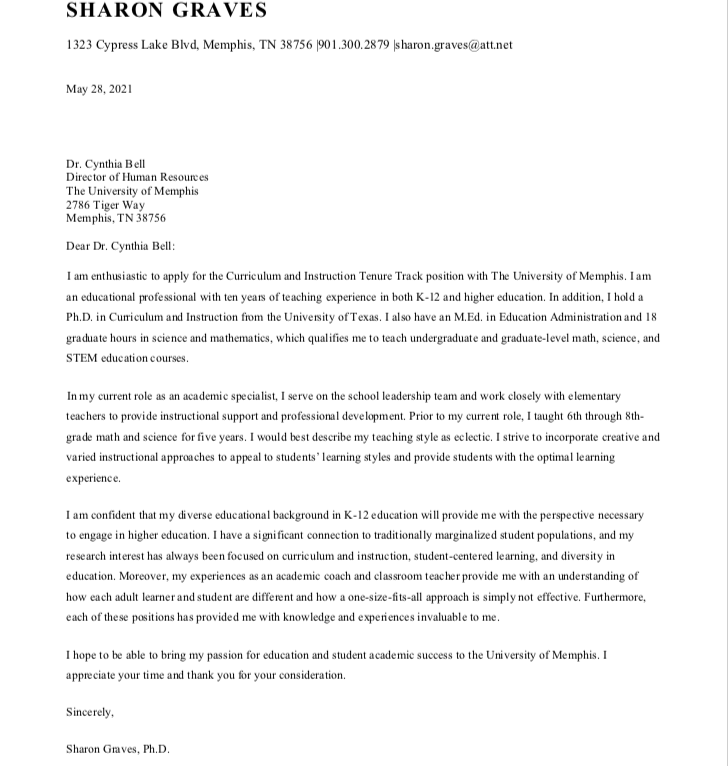
This is an example of a detailed cover letter.
The last step is to review the entire application, including your resume and cover letter. Check for employment gaps, grammar and mechanical errors, and that you have included all requested documents.

Employers screen prospective employees by their ability to follow instructions. Although applications generally ask for the same information, it is important to adapt each application and supporting documents to address the job requirement.
I would love to hear from you. If you have questions or would like to share your thoughts about the post, please comment below.